Zionism: seeing the Nation-state in a warped mirror?

I regard Zionism as a problematic political project. The essence of it entails the exclusion of everything non-Jewish, and its actual implementation in the shape of the state of Israel has created a militarist state that oppresses and dispossesses a large number of human beings – because they are not Jewish. I suspect that this state of affairs not only causes suffering externally, but also causes suffering among Jews in Israel because of the violence and the negative effects of militarism. A martial society blocks many forms of social development.

My understanding is that ZIonism is a response to the European Nationalist projects of the 19th century. These projects both challenged what it meant to be Jewish in a European Nation-state, and suggested a way out of the dilemmas that arose (“am I Danish or Jewish?”) in the shape of a Jewish Nation-state. Thus Israel is no different from, say, Poland: a country for Poles.

There are differences, though, and these are generally not recognised by the world in general. They are certainly not part of the public discussions about Israel. In my view the Israeli, Zionist project, entails a far more extensive and more sinister form of exclusion than most Nationalist projects – but I admit this is open to debate. The Kurds in Turkey spring to mind

More on that elsewhere.

The ideal of Zionism is a state that is for Jews only. Exactly what this entails in terms of the role of the Jewish Church, I do not know; it is sufficient to note that a state FOR Jews must exclude the others, those that are not defined as Jews.

How does this compare to, say, the Danish notion of Nation? After all, Denmark exists to look after the interest of the Danish people, by drawing a border around them and letting them tend to their own affairs. And indeed, the notion that non-Danes, Turks for instance, have any business in Denmark, is anathema to many Danes. But not all, and not to the law, nor to the Danish state institutions. So while migration challenges the concept of the Danish Nation state, the reality of the Danish state absorbs the challenge: the migrant is allowed in by a vetting process, and once inside, gains the same rights as the “indigenous” population. Everyone is equal before the state and the law.

In Israel, this is not true. Everyone is not equal, since the Jews are a lot more equal than everyone else. This is a fact, though not widely acknowledged. One of the reasons it is not acknowledged, is that it is hidden in plain sight. Everybody knows of the Law of return, the settlements, the Occupation, the Wall. These all operate along the same divide: Jew and non-Jew. What´s more, in Israel, large quasi-non-governmental organisation like the Jewish National Fund fulfill key roles in controlling access to land. These organisations exist, according to their charters, to look after the interests of Jews. This in itself is not problematic, but when these organisations are given huge power by the state, and the state withdraws from the same areas of jurisdiction, the net effect is that the state discriminates in favour of some of its own citizens, and by extension, against other citizens. Reading the Wikipedia articles on eg JNF give some idea of their character, but you need to dig deeper. Try Adalah.

While the modern Nations-states all embody the contradiction of inclusion / exclusion, none are anywhere near Israel in their commitment to excluding those persons that are not included, those that are not Jews. For Zionism, they are are not wanted. But they are there.

Post scriptum: If you Google this topic, you may stumble upon this article: http://www.meforum.org/370/can-arabs-buy-land-in-israel . It is a well written piece of propaganda, but gives the game away in some of the details (the odd Bedouin gets some land for his flock) and omits the big picture. It is also worth googling the author and visiting the homepage at http://www.meforum.org to see which angle this is coming from.


Update October: Ilan Pappe on a similar topic: http://www.globalresearch.ca/reclaiming-judaism-from-zionism/5355123

Cross country skiing

Schoutbynacht has been xc-skiing tonight. Actually, the picture was taken a few days ago, so tonight the moon was even larger. No need to light the headlight, which broke anyway when I had a drink of water and ripped the cord.
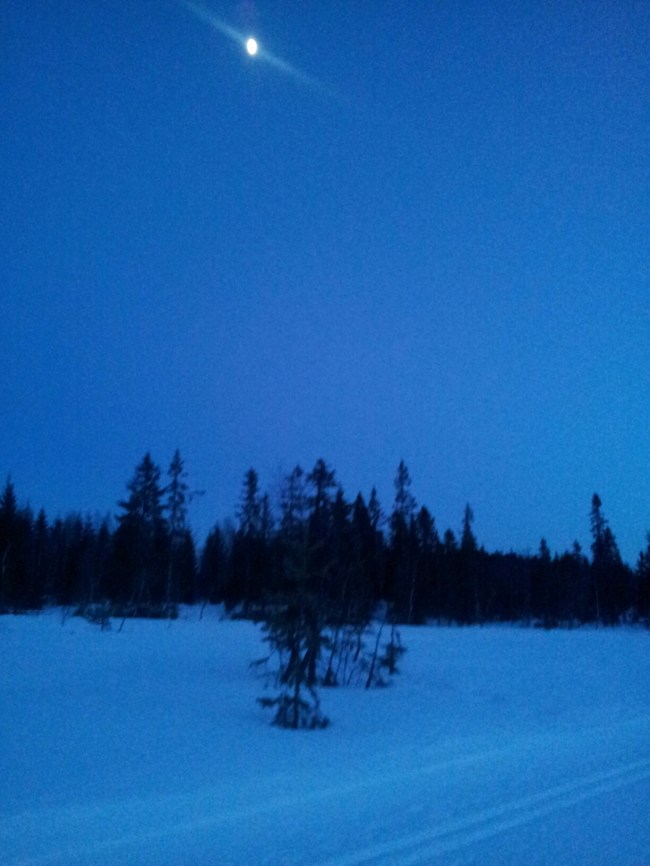
Image

This year spring is late in Norway, and so the snow is amazing for this time of year – dry powder. Normally by now it would be all crystallised by the constant oscillation between daytime sunshine and nights with minus five, six, ten. Instead, the snow is still dry and quite clean, not full of pine needles and bark. So conditions are great for classic style XC using normal wax – blue extra, for instance. Plenty of grip.

So I got out and hit the snow at 8pm when the last daylight was receding – just a faint stripe over the treetops to the north west. One other car in the car-park, and over one hour and forty minutes I saw two people, none of whom returned my greeting, and one dog, which barked with a certain amount of enthusiasm and no ill intent from what I could see. No moose, either, though I must say I was on the look-out. There are plenty in the woods here, I have met them twice, and while they are generally no trouble, they are HUGE, and if they decide to go for you, you better get outta there. So, no elk tonight. Just quiet trees and moonlight filtering down. Makes for a slightly spooky atmosphere, one you can break or spoil by lighting the super mega LED-light that you have on your head. But I didn´t, preferring to go by moonlight. This also sharpens, and by a lot, your sensation of skiing. Your perceptions shift from sight to balance, you start to feel what the body is doing, the pressure of your feet in the shoes, your position on the skis, the jolt transmitted back up your body as you kick the ski down. The smell of pine trees and snow. You get closer to nature. The root of a fallen tree with snow on it towers up ahead looking like a human shape. A shiver runs down your spine. Then you see the moss, the tiny roots, the shape changes into a tree-root shape. Small wonder trolls are popular in Norway. The forest is full of them.

Speed is also higher in the dark. It´s not really, but it feels it, which is more satisfying. Speed, the sensation of speed, is central to skiing. That, and the feeling of power and control. Power, as you thrust yourself forward on the slippery surface; control when you zoom down a slope at speeds exceeding 40 km/h on thin skis and manage to stay upright, clear the curve that comes up ahead, and make it through until things quieten down, the slope decreases, wow, made it!

My plan was to make it to Mikkelsbånn, but I don´t really know where that is, so I turned back when I thought I had come far enough. I drank some water, listened to a plane receding into the distance, verified that the headlight wire was beyond immediate repair, then set course for home, and discovered that it was almost all downhill and a fair bit quicker than coming up.

And I started to think how skiing is a constant element in my life. I remember my skis like I remember my bikes, with the exception of my first skis. There is the photo where I am 4-5 years old, on skis. Those I don´t remember. But the next pair, wooden, Åsnes, with a big Å on the tip – yes. The sole had to be made impermeable by smearing it with a tar-like substance, much like boats in the old days. Failing that, in wet conditions they would ice up like nobody´s business. This tar was also quite flammable, and I have this picture in my head of a common occurrence: when applying sticky wax for icy snow – klister – people would sometimes use a gas flame to heat the damn stuff and make it more malleable, and inevitably all the chemicals would catch fire. Nice blue flames until they petered out on their own accord.

The next image that presents itself is of my Åsnes skis being loaded onto the train in Bergen. How we got to the train station I cannot remember. With my dad it was often a case of being somewhat late – but in any case, the skis were surrendered to the cargo handlers, and equipped with labels. I remember paper stickers that were moistened and attached to the skis, stating the destination, and cardboard labels with a metal-reinforced hole where a steel wire was inserted in order to attach it to the skis, the poles, or other items of luggage. The poles! They were made of bamboo! Sounds like the Middle ages, but we´re in the late 70s.

Then we got on the train. The compartment was hot, the chairs were deep and comfy with green, plush upholstery. They swivelled, so you could make everyone face in the direction of travel. You pressed a pedal, and the whole two-seater could be flung through 180 degrees – clack! Clack! Clack! You sank into those chairs, you did not sit on top of them. They were great. And the train pulled out of the station and into the first of a million tunnels dug by grimy-faced rallars all those years ago. Narrow, black, wet tunnels. It seemed a miracle the train fit inside it. But it always did, and we with it.

The trolley came down the aisle, and maybe we got a bottle of Solo. Sticky, sugary, and ultimately nauseating as the train snaked along the mountainside before starting the climb to 1222 meters above sea level. Relief may have come from the water flasks, one of which was available at either end of the car, which by the way, was divided by two central glass doors that divided smokers from non-smokers. The water flask was made of glass, with a narrow neck, and was filled with tepid, lifeless water. Next to it was a stack of wax-paper cups. These were tiny and rather ingenious, having been fashioned from a single circular sheet of wax paper folded  into a cup shape. By pulling along the edges you could return the cup to its flat origins, and colour it. Thus passed a half hour. Many more remained until we reached our destination, late in the evening.

We stumbled out of the train, down the steep steps to the platform, snow-covered and lit up by yellow lamps. A cold dry wind would be howling in from some frozen mountain lake, and the train was a sight! The dry snow was like comet´s halo around it at speed, and this snow clung to every nook and cranny, and even to the bare metal, giving the train a heroic appearance. This was no ordinary journey! This was a fight with the elements! At the front, the locomotive had snow all over its plough and the metal grid protecting the nose. The bellows between the cars were all snowed up! Snow everywhere. The train just blasted through, or so it seemed to me, with a mighty mechanical force.

We hurried off the platform, walked the few hundred yards to the hotel, how I longed go get into that warm hotel lobby with its reindeer antlers, reindeer hides, thick slate tiles on the floor, Kvikk Lunsj and Melkesjokolade on display in the reception together with today´s paper from Oslo. Check in, collect the keys to the room. A normal key attached to a huge metal keyring. It was a roughly t-shaped piece of heavy metal – brass? The bar on the T was circular and padded externally by a rubber ring. On the surface of the circle the room number was stamped in black. There was little chance of carrying this key home inadvertently! Each key nestled in its pigeonhole in the reception, and all we had to do was ask for it whenever we needed to go the room to fetch something.

Finally we got to the hotel room with its strange smells of carpet and detergent, its starched white bedclothes, cool to the initial touch, then warm, so warm that sleep came instantly, even if by now we may have been a little bit excited.

And the next day would break with a light breeze, a blue sky, and a few degrees below zero, and we would equip ourselves with a packed lunch and a thermos flask with cocoa and launch ourselves on the newly-prepared tracks that fell away from the hotel down to the frozen lake, traversing it in a straight line like yesterday´s train tracks.

Tits & Clits (Stephen Jay Gould in memoriam)

Schoutbynacht is a big fan of the late Stephen Jay Gould´s popular writings.

One of Gould´s essays is called “Male nipples and clitoral ripples”, since his wife thought the more catchy “clits & tits” was a bit too much. The essay is about economy of genetic description, and how the architecture of man and woman is very similar. This explains why men have nipples, even if they don´t serve a purpose. The description is there in  our genes, which is much easier to “do” than to delete the entire organ. The difference is that  the milk glands do not develop in males. Similarly, our genitals are very similar at an early stage of life, and then mature along different paths. To make a long story short, the penis corresponds to the clit, and they have very similar structures, and in particular, are connected to the brain by a huge number of nerves. Basically, the clit is the main source of orgasm in females, which is a bit of a pity since it does not get much stimulation in normal intercourse. Presumably Gould´s wife benefited from his insights into the female anatomy, an insight Gould must have shared with the manufacturers of battery-powered vibrators. Vigorous stimulation of the clit is the key to success. Which implies that in addition to intercourse, a separate phase of love-making is called for, whose focus is solely to bring the female to climax.

There are articles that describe the clit in more detail – in particular, it turns out to have a large hidden structure under the skin, so to speak, which probably explains why intercourse in itself is also pleasurable, and can make a woman orgasm from the inside. Gould did not write about this, but you can explore it yourself.

To sum up, the old “wham bang thank you ma´m” just does not cut it. To love a woman properly takes more than that.

Om å lære av historien (Afghanistan)

(skrevet i 2006, redigert for klarhet her og der)

For omlag 170 år siden invaderte britene Afghanistan i den første av de tre afghanske krigene. Invasjonen den gangen – i 1838 – lignet i mangt og meget på situasjonen da Sovjetunionen invaderte, og er heller ikke ulik dagens. Britene oppgav som påskudd i at de var invitert inn av en avsatt fyrste – Shah Shajan – og tok landet uten større kamphandlinger. De etablerte seg i Kabul, men hadde liten kontroll over resten av landet, og inngikk skiftende allianser med lokale makthavere som snudde kappen etter rådende vinder. Allerede etter 3 år var det over. Det endte i et blodbad, der den britiske armé samt tjenere og familier marsjerte ut av Kabul  6. januar 1842 etter en avtale om fritt leide med klanoverhodet Akbar Khan. Afghanerne holdt ikke ord. Av de om lag 16.000 soldater og sivile som satte ut på ferden, overlevde én eneste soldat forræderiet og de konstante angrepene, og kom fram til målet i Jalalabad.

I  Rudyard Kiplings ”Arithmetic on the frontier”, lyder to av de sentrale strofene slik:

A scrimmage in a Border Station—
A canter down some dark defile—
Two thousand pounds of education
Drops to a ten-rupee jezail
The Crammer’s boast, the Squadron’s pride,
Shot like a rabbit in a ride!

No proposition Euclid wrote,
No formulae the text-books know,
Will turn the bullet from your coat,
Or ward the tulwar’s downward blow
Strike hard who cares—shoot straight who can—
The odds are on the cheaper man.

Diktet beskriver hvordan ”the cheaper man” – koloniundersåtten – med sitt billige våpen, i dette tilfellet en enkel muskett med lang rekkevidde kalt jezail, feller den høyt og dyrt utdannete britiske soldaten, og hvordan allverdens tekstbøker og teoretisk kunnskap er verdiløs mot geriljakrigeren. Diktet er skrevet i 1886 og viser til den andre afghanske krigen, som igjen satte vestlig soldat mot stammekriger – den varte fra 1843 til 1880.

Krigene i Afghanistan på 1800-tallet skjedde mot et bakteppe av internasjonal rivalisering om et strategisk viktig område – The Great Game. Russerne presset på fra nord og britene fra sør, og deres interesser og maktkamp møttes i Afghanistan. Landet ligger like strategisk plassert i dag som den gang, selv om det større strategiske bildet har endret seg. I dag ligger Afhanistan som en propp mellom russiske interesser i nord, Iran i vest og Pakistan i øst og sør. En eventuell gass- eller oljeledning fra Kaspihavet til det Indiske hav må gjennom landet, noe som var bakgrunnen for amerikanske Unocals samtaler med Taliban i 1997. For vesten og amerikanerne vil kontroll over Afghanistans utenrikspolitikk og allianser ha stor verdi, ved at Iran da blir ”gjerdet inn”, det demmes opp mot russisk innflytelse fra nord og mot de islamistiske kreftene i nord-vest Pakistan. Strategisk kontroll og innflytelse er like viktig i 2008 som for 200 år siden; det er stort sett kun navnet på aktørene og innholdet i retorikken som har endret seg.

Hva skal man  tro om Norges engasjement i Afghanistan?

Fikenbladet Al-Qaida stod til nød til troendes i 2001, men vi har siden sett at Bin-Ladens beste venner snarere befinner seg i Saudi-Arabia og ikke minst Pakistan, våre allierte foregangsland innen demokrati og menneskeretter. Grunnene for militær intervensjon som trekkes fram i dag, seks (10!)(20!) år etter invasjonen, er knyttet til menneskeretter og Talibans kvinnefiendtlighet – argumenter man umulig kan være uenig i; argumenter det derfor er grunn til å være dypt skeptiske til: de er lette å ty til.

Norges objektive interesser i Afghanistan er sterkt begrensede, like begrensede som vårt militære nærvær der. Som del av en allianse hvis strategiske dagsorden vi i noen grad deler, må vi imidlertid smake steken. Man kan ikke være med i NATO uten å ta del i NATOs engasjementer og strategiske utvikling, og dermed vil man uvegerlig opptre som en marionett for amerikanske interesser, i og med at disse dominerer i NATO.
Slik også med menig Olsen fra Løten og hans kampfeller, de neste ofre for de moderne jezailer – veibombene. Brikker i et sjakkspill. De sendes ut for å dø, nå som i 1838, nå som til alle tider, med nasjonal patos og forsikringer om at de risikerer livet for en god sak og at deres mandighet er upåklagelig. Det er kanskje best om de aldri oppdager at de ble holdt for narr.

Vil dagens (2006) militære intervensjon i Afghanistan lykkes? Det spørs hva målet er! Men det er all grunn til å anta at invasjonsstyrkens mål ikke sammenfaller med afghanernes mål, og da er det lite som tyder på at konflikten vil bli kortvarig. Historien har tallrike eksempler for den som vil lære av dem.

Generalkonglomeratet

Helt siden de første ukene etter at Generalkonglomeratet kom i drift hadde en diffus følelse av at noe ikke var helt som det skulle spredd seg i konglomeratets omgivelser. Imidlertid var følelsen så diffus, så lite håndgripelig, og dessuten tildels så pinlig, at de alle fleste vegret seg for å si noe som kunne avsløre hva de tenkte. Det lengste de fleste strakk seg til var en kryptisk kommentar i heisen når de besøkte Generalkonglomeratet. ”De har sannelig raske heiser her i GK” (GK var den vanligste forkortelsen for det som i virkeligheten het ”Generalkonglomeratet for alt mellom vugge og grav”). Samreiserne i heisen nikket saklig og sa seg enig. ”Ja sannelig har de raske heiser”. Mer ble der ikke ytret om den saken.

Flere år hadde nå gått siden dørene til GK ble åpnet til taler og hornmusikk. I sakens anledning ble det fra høyeste myndighetshold fremholdt at man hadde Store Forventninger til det nye Generalkonglomeratet. Nøyaktig hva som lå skjult i uttrykket Store Forventninger ble ikke nærmere utdypet, ikke minst fordi dette ble uttalt av landets ypperste byråkrater, dertil med betydelig prosodisk understrekelse av adjektivet ”Store”. Om det ikke ble utdypet, så ble det likevel utvidet: ”sjelden eller aldri har så mye byråkratisk og juridisk kompetanse vært samlet under ett tak her i Riket”, la de til. Taket det ble siktet til ruvet i seg selv, hele søtten etasjer hadde det nå under seg, etter at bygningen i forbindelse med en generell oppussing hadde blitt utvidet med en toppetasje i rikelige mengder plexiglass, titanium og utarmet uran. Selvsamme toppetasje ble kalt ”kommandobroen” av konglomeratets hærskare av byråkrater, i og med at det var her oppe, med luftig utsikt over Byen og dens berømte profil med Rådhusets karakteristiske tvillingtårn, iblant forvekslet med en transformatorstasjon av tilreisende, at konglomeratets ledelse henslepte sine dager. Forventningene var det med andre ord ikke noe å si på, ei heller de fysiske og menneskelige rammebetingelsene. Det var bare å skride til verket.

I de påfølgende årene hadde konglomeratet etablert sin arbeidsform og en jevn strøm av materiale og immateriale fløt inn og ut av den høye bygningen. Gjennom telekommunikasjonslinjene ble det utekslet en jevn strøm av data med omverdenen. Varebiler kom og gikk, med brev og pakker inn, brev og pakker ut. Mat ble kjørt inn og søppel ble kjørt ut. Gjennom de tallrike rørene under bakken ble bygget tilført rent vann, og kloakken ble ivaretatt på beste vis. Saker ble opprettet og saker ble lukket og arkivert for ettertiden. Det var intet å utsette på noe som helst. Alt fungerte. Alt var i skjønneste orden.

Likevel, som sagt, de små kommentarene i heisen var et element som skurret. Når man roser en bagatell, kan det ligge en skjult kritikk i kommentaren, noe som så mange har fått smertelig erfare. Heisene var altså raske, og ære være dem for det. Tysk finmekanikk smurt med petroleumsprodukter fra de store havdyp! Bedre enn det kunne det knapt bli. Men som sagt, bak denne rosen lå det et visst ubehag, et ubehag knyttet til at de besøkende følte seg døsige, ja, rett og slett søvnige! Heisenes muntre hvisling i deres sjakter brøt inn i døsigheten. Her var det noe som gikk fort og friskt og livlig! ”Sannelig raske heiser!”. Replikken datt ut av munnen på mer enn en besøkende, og han eller hun tok seg beskjemmet i det. Hvem ville vel innrømme at de var døsige, enn si søvnige, midt på arbeidsdagen? Det kunne sågar være om morgenen, etter ett av statusmøtene der konglomeratet møtte en av mennene med Store Forventninger. Hvorvidt disse forventningene noensinne var blitt møtt, var i parentes bemerket aldri noe tema. Det ville vært å bryte et av byråkratiets grunnleggende tabu.

Men se det! Selv i de tidlige morgentimer kunne en besøkende bli grepet av en slik døsighet at den skjebnesvangre replikken formet seg i hans underbevissthet og fant veien til talesenterets motornevroner før overjeget rakk å gripe inn!

De besøkende ble altså rammet av en nærmest lammende søvnighet etter å ha oppholdt seg noen tid i bygningen, uavhengig av etasje eller andre omstendigheter. Hvorvidt de som hadde fast tilhold i bygningen også følte det slik, vites ikke. En mulig pekepinn på at så faktisk var tilfelle finner vi i det faktum at tilførselen av kaffe per medarbeider lå noe over middelforbruket for kontorarbeidere i Riket. Dette var et faktum som imidlertid var skjult i hauger av ordrer og fakturaer, og ikke inngikk i konglomeratets årsrapporter. Hvorom allting er, så vites lite om det interne livet i Konglomeratet utover det eksternt observerbare, og det er allerede omtalt i de foregående avsnitt.

Vendepunktet kom en blek vintermorgen da en vedlikeholdsarbeider snublet inn på et mørkt rom i konglomeratets kjeller. Det var et rom som hadde stått uberørt i mange år. Hvilke planer som lå bak vedlikeholdsarbeiderens innsnublen skal det ikke spekuleres i; uansett kom denne hendelsen til å bli et Vendepunkt, om enn et lite omtalt Vendepunkt.

I rommets mørke kunne man skimte tre store trykkflasker som var koblet med slanger til et tykt aluminiumsrør av den typen man vanligvis finner i ventilasjonssystemer. På flaskene var det ventilratt og manometere, og med store røde bokstaver sto det skrevet ”Oksygen”.

Vedlikeholdsarbeideren tente sin lommelykt og lot lysstrålen falle på manometrene. De første viste at flaskene var fulle. De neste viste at ventilene var lukket.

Etter at ventilene ble åpnet forstummet samtalene om heisenes forbløffende hastighet.

More naval stuff

Schoutbynacht has a maritime theme, and once it caught my attention, I couldn´t let it go, and then I started to think about all the stuff I have read about naval life, and it´s a lot and goes all the way back to my childhood. The recurrent, strong theme seems to be the tragic and dramatic, and surely that is why the sea is so appealing – from HMS Ulysses by Maclean, all the way to Taifun and Lord Jim by Conrad, via books like “Jutland 1916”, various sinkings of the Bismarck, the Tirpitz and the Scharnhorst, Trafalgar, the Italian Navy in WWII, the story of Stord and the other Norwegian destroyers in the Royal Navy, MTBs and subs operating out of Shetland, the British midget subs attacking Tirpitz.. The sinking of the “Najaden” at Lyngør in 1812!

Schoutbynacht is a part of me. I have also taken my turn at the wheel of a vessel and sat under the odd wet sail – but that´s about it. Nothing to brag about. No no. Not at all. And who doesn´t go sailing, anyway?

So I am an armchair sailor.

From my armchair I can follow the sailors as they prepare for the floating slaughterhouse at Trafalgar, where Nelson was shot by a musket at close range, and thousands of sailors, mainly French and Spanish, were killed by cannon fire and flying splinters of wood.  I can imagine the mayhem at Aboukir bay when the gunpowder magazine on the French flag ship “L´Orient” blew up at the Battle of the Nile. Black gunpowder is very explosive and burns much faster than the later, smokeless gunpowder known from long-barrelled guns.

Spooling forward to 1916, some 200.000 sailors were in action in what was the largest naval battle ever – there will never be a battle like that again. The battle was won  – numerically – by the German side, but strategically, it sealed the fate of the German navy, by proving that it could not achieve any of its goals. The Germans had the better gunsights, the better artillery, and better ships, but were numerically inferior, and locked in by the British Isles, which meant that the Atlantic was out of reach. This repeated itself on a smaller scale in the second world war. The Bismarck was a fantastic ship, but she operated alone, with support from only one ship, the Prinz Eugen, and you cannot wage war against the Royal Navy with two ships, however brilliant they may be. And so she went down on her maiden voyage, in May 1941. With hindsight, it was bound to end that way.

You cannot but admire German engineering, though 🙂

One thing I realised while reading “Battleship Bismarck” by Burkard Baron von Müllenheim-Rechberg was what any architect of battleships knows , namely that such a ship is always a compromise. You need armor to protect against enemy shells, and by 1916, and indeed 1941, the main armor was thick enough to deflect a direct hit from the enemy´s main guns – at least under favourable circumstances. But you can´t have armor everywhere, and so the vessel is vulnerable. The superstructure, the fire guidance systems, all of this is high up on the vessel and cannot be heavily armored. So if a vessel is subjected to a sufficient amount of fire, it will be incapacitated.

And sometimes the main armor is not strong enough to protect the vitals, like the gunpowder magazines – Santabarbara in Italian, named after the patron saint of naval gunners. This is what caused the end of three British battlecruisers at Jutland and the HMS Hood in May 1941 (The Hood was a WWI design), in a short battle with Bismarck. The end of HMS Hood may have looked a bit like the end of the HMS Barham, whose demise in the Mediterranean was filmed. Look it up on Youtube.

After WWII I lose interest in naval warfare. It will never be the same again, with missiles and torpedoes and aircraft carriers.

Schout by nacht

(Nederlandsk schout-bij-nacht) er en militærgrad til sjøs på 1700-tallet som i dag tilsvarer kontreadmiral.

Hva har det med meg å gjøre?

Det dukker opp i bøker jeg leser. Jeg liker ordet. Det er uvanlig.

Første gang jeg kom over ordet var i en tegneserie om Tordenskjold. Han vokste opp i Trondheim og kom etter hvert til Kongens København der han gjorde karriere i marinen, og etter hvert fikk graden Schoutbynacht – den som speider om natten – eller kontréadmiral, dvs den admiralen som har ansvar for den bakre delen av flåten, “rear admiral” på engelsk. Under slaget ved Trafalgar i 1805 var Collingwood Nelsons rear admiral, hans Schoutbynacht.

Thorkild Hansen har skrevet en bok om en dansk mann som levde i overgangen mellom 1500 og 1600-tallet, Jens Munk (eller min egen artikkel). Han kom til den brasilianske byen Bahia de todos los Santos på et nederlandsk skip – “Schoutbynacht”  – som ble oppbragt av en fransk pirat. Jens Munk reddet seg i land, og var der noen år. Siden ledet Jens Munk Kristian IVs ekspedisjon til Hudson Bay, der han nesten gikk til grunne.

Så der har vi Schoutbynacht igjen.