Wenn jemand ein Reise tut, so kann er was erzählen (if someone undertakes a journey, then he has a story to tell)
Last time in Germany was 2012, Berlin.
I haven’t written about that, and now the memories are faded – though not entirely. The way history lived in the present made an impression on me. The Holocaust denkmal is an obvious example – but it was also striking to see how the bombing of the city had left an erratic pattern of old and new-ish buildings. We can assume that some bombed buildings were reconstructed in their original thus masking the past destruction, but others had been built in a new style that made the fact of the bombing a part of the present. Here a house was bombed. Civilians were killed.
Neue Wache; the single statue by – what’s her name again? Similar theme – loss, destruction, grief.
Certainly resonates in me.

And here we are in München, fresh off the plane, fresh from navigating a somewhat confusing public transport system with paper tickets (!). Four young people at the start of their lives, and maybe careers, too – what direction should I take? with each a bassoon slung over their shoulders, and the obligatory wheeled suitcase.
Dag is our host at the Hochschule für Muzik und Teater. He greets us in a building that the Nazis built in the late 1930s, their first major building, apparently. Führerbau. This is where the Munich-treaty was signed in 1938. We walk the same stairs as Chamberlain and Hitler walked.
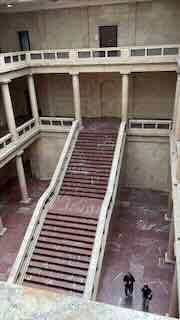
The rehearsal takes place in a room which was not built for the purpose, but it’s spacious, so the seven guests can squeeze in without trouble. Dag is teaching Tamar from Israel, preparing her for a big competition. We listen and learn.
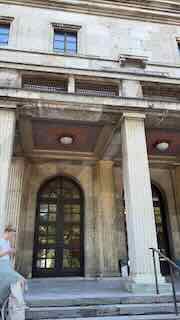

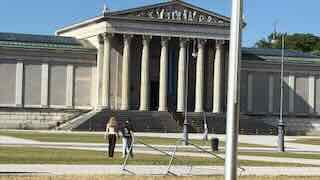
Next door are huge buildings from the era when Bayern or Bavaria was a kingdom in its own right. Lots of Greek facades to make a statement backed up by large volumes, sitting in open spaces.
There is also a museum about the horrors of Nazism, this time with München as its focal point. NSDAP gained early support here – the infamous Beer Hall Putsch took place here. https://en.wikipedia.org/wiki/Beer_Hall_Putsch.

A reproduction of the party programme from 1920 states a few points clearly:
– All Germans must be united in one Germany (watch out Austria and Czechoslovakia)
– Germany must take its rightful place among nations and the Versailles-treaty must be overturned
– Germany needs land and soil (colonies) for its population surplus ( this became the genocidal displacement and killing of millions of Slavs, not least ethnic Poles, Ukrainians, Belorussians, and Russians (Drang nach Osten)
– To be a good German (Volksgenosse) is a question of blood, and therefore Jews have no place in Germany
Later, München was bombed by the allies, with the number of victims running to about 6000. In the East, troops from München took part in massacres of civilians. The photo is from the massacre at Celje on 22nd July 1942, when 100 civilians were shot in reprisals.

At night we attend a concert with BRSO, Simon Rattle. The venue is the Herkules-saal in the “Residenz” of the Bayerische kings of old. The building complex is positively enormous, as befits a kingdom. The audience typical of classical concerts – well dressed, well-proportioned humans. And tall! The women here are really tall – at least those that attend classical concerts. Someone should run a statistical analysis on this.
There are enormous monochrome – blue – paintings along the top walls. Scenes of enormous Greeks dying. Herkules must be assumed to be among them.
The concert is great, even if my young fellow traveller says the repertoire is easy. We agree that Mozart is boring, however well executed.
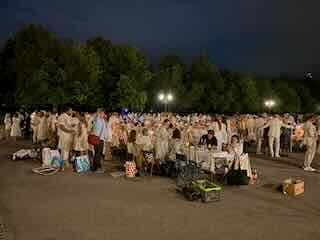
As we walk out into the warm evening we are confronted by a somewhat disturbing sight. The large park that abuts the building is hosting a late-night garden party where every guest, man and woman, is dressed in white. An invisible line divides us, concert-goers, from the party guests. If they white-clad had had a political programme, it would have been most disturbing.
Deutsche Bahn takes us to Stuttgart and then Weiblingen where we visit a bassoon factory. Germany is home to the bassoon – both in terms of schools, orchestras and factories. We are met by Bernd Moosmann at the railway station, one stop from Stuttgart. Bernd is an affable man in his mid 60s who speaks excellent English with a German accent. Like a movie, really, since movies reflect reality. In the middle of the industrial area where the factory sits, a two-storey building looking like a modernist villa, there is an Italian restaurant run by – Italians. The orechiette are good, but hardly homemade, as they were claimed to be!
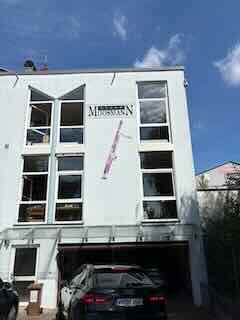
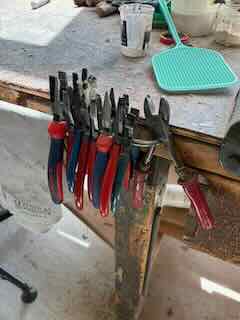
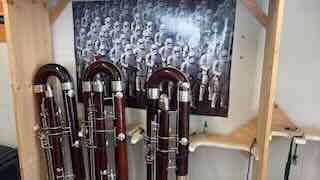
The factory is small, artisanal, with old-fashioned tools bar one CNC-machine. Labour intensive. Beautiful products. Bernd runs the shop paternal style with his wife, daughter and son-in-law. And the dog, Dexter? A huge, brown Labrador doing what Labradors do – lie in the middle of the doorway and roll over to be petted. We get to try plenty of very nice bassoons!


Bernd takes us to the railway station again, we while away a few hours in Stuttgart’s Königstrasse, and then get the train to Mannheim, and another hotel. We catch some Miso ramen before they close at 10PM… on a Friday night! and then marvel at the constant stream of expensive Mercedes and BMW – but no Porsches – with young people driving down the drag strip. 2 to 4 people in each car, no-one over 30. All dressed to kill, every square millimetre of skin groomed to its limit. Many a loud exhaust-bark dot the mating ritual.
After breakfast in a café we get to spend some time with the extremely funny and extremely competent Ole Christian at Die Staatliche Hochschule für Musik und Darstellende Kunst in Mannheim. Darstellende Kunst must mean “performing arts”.
We pile into a Vietnamese joint for some noodle salad – quite insipid – and then Ole C is off; we adjourn to the hotel to play bassoon for a while. It’s hot in, it’s hot out. I walk down to the Rhine. It’s full of water, and quite dull apart from that. Grassy banks, a pedestrian underpass completely covered in graffiti, but otherwise tidy, apart from freshly spent spray cans.

Since Mannheim was flattened by the RAF during WW2 the architecture is a disaster. But I find it more charming than either Stuttgart or München, mainly because of the street life. What is a city, if not its street life?
At 4 PM the train to Hamburg departs. A large chunk of Germany lies ahead of us, and Deutsche Bahn takes us through it comfortably, almost unobtrusively.
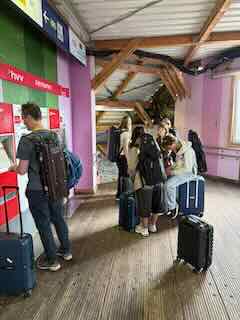
Hamburg again presents us with an old-fashioned and intricate ticketing system for the local trains. We buy some tickets for appearances’ sake, they arrive printed one-by-one with the obligatory receipt at the end.
For the first time in Germany we can get sandwiches and cinnamon buns late at night – as you would in Norway. We make the most of the opportunity, then put our feet up in the hotel reception with some relaxation-inducing beverages.
The next day is Sunday, and Niko graciously opens Tutti Fagotti for us in an office building in dowtown Hamburg, The “HH” on the license plates is short for “Hansestadt Hamburg”, in case you wondered. You didn’t?
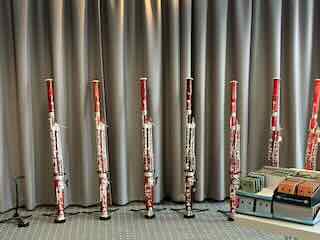
We spend four hours trying a number of expensive bassoons, until the ring of the bell tells us we have a plane to catch. The young ones have made their judgements, will it result in a sale? Time will tell.
It’s always good to touch down on Gardermoen, and as usual I get lost on the illogically marked parking lot – but I find the car in the end. And the book we all should read is “East West Street” by Phillipe Sands…


